


A key breakthrough in the field of enzyme-catalyzed photochemistry!
2023-09-28 09:58
A few days ago, Professor Chen Xi from the School of Chemistry and Materials Science of Northwestern University cooperated with Professor Wu Yuzhou and Professor Zhong Fangrui of Huazhong University of Science and Technology.Nature 主刊在线发表文章“ Enantioselective [2 2]-cycloadditions with triplet photoenzyme s”。
Enzymes are important components of life. Enzyme catalysis has the characteristics of high efficiency, high spatial selectivity and green environmental protection. In recent years, there have been many breakthroughs in the field of synthetic biology in the modification and directed evolution of enzymes, but there are few reports on the efficient photocatalysis of enzymes.
This work is a key breakthrough in the field of enzyme-catalyzed photochemistry.. Researchers integrated triplet energy transfer, a typical photocatalytic mode, into proteins, and inserted functionally modified unnatural amino acids into proteins through gene reprogramming to create artificial photoenzymes containing triplet photosensitizers, which successfully catalyzed the intramolecular [2+2] photoexcited cycloaddition reaction of indole derivatives, in addition, the enantioselectivity in the process of [2+2] photoexcited cycloaddition reaction can be controlled by the non-covalent bond interaction between the stereochemistry of artificial photoenzyme and substrate molecules, and the enantioselectivity of up to 99% e.e can be achieved.
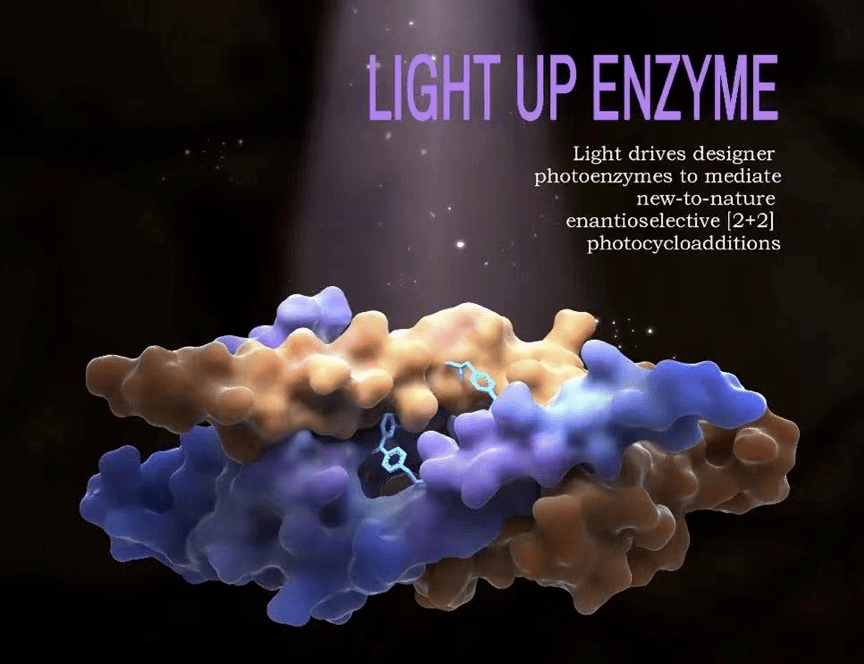
Artistic Schematic of "Triplet Photoenzyme"
The evolution of the artificial enzyme has gone through four stages.By the third stage (TPe 3.0), the e.e. value reached 93%. In order to further optimize the enzyme, Professor Chen Xi's team analyzed the crystal structure of the complex of the artificial photoenzyme and the substrate, and revealed the mechanism by which the energy transfer activity of the artificial triplet photoenzyme in the supramolecular protein cavity was greatly improved and the high spatial selectivity was catalyzed: in the hydrophobic protein cavity, light energy was transmitted from the unnatural amino acid to the substrate through π-π accumulation, activating the reaction. The weak interaction between the substrate and the surrounding amino acid residues determines the single chiral conformation of the product. Based on this mechanism, the research team designed TPe4.0_FBP, which mutated alanine at position 11 to asparagine, increasing the hydrogen bond between the amino acid residue and the substrate. At the same time, a fluorine atom is added to the non-natural amino acid, the π-π conjugation is increased, and a C- F hydrogen bond is increased. Based on these modifications, the e.e. value eventually reached 99%. Professor Chen Xi's team also successfully analyzed the complex crystal structure of TPe4.0_FBP and substrate (follow-up work), and verified this mechanism.
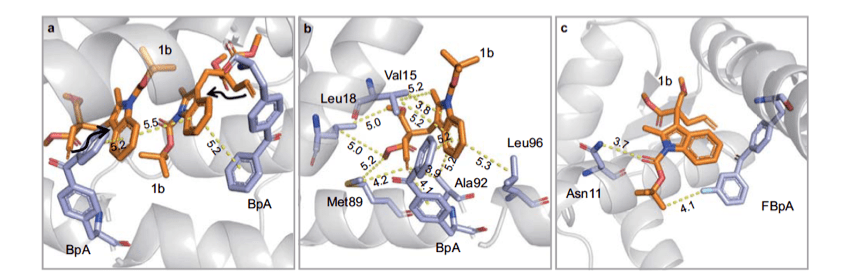
Catalytic mechanism of "triplet photoenzyme"
This research work combines chemical photosensitizers with protein structure to create a new type of "triplet photoenzyme", which enriches the function and application range of light-driven biocatalysis. At the same time, it realizes the master control and provides core technical support for the development of medicine, pesticide, information and materials.
More news
Contact Us
Add: Modern Industrial Park, Yueyang Economic and Technological Development Zone, Yueyang, Hunan,China